Server — others browse your library
UPnP is a protocol for audio devices to find and drive each other over a local network, and within it every participant plays one defined part. With the Server role on (the UPnP Server switch), MusicBee plays the Media Server part: it answers discovery requests on your LAN and serves its library to any device that asks. From the other device you see a media tree and tap to play; the audio streams from MusicBee's built-in HTTP server straight to the device. MusicBee is just the source — the other device is in charge.
Why you'd use it. It turns the one PC that holds your whole collection into a network source every other gadget can reach, without copying files or signing into anything. This is the half of the plugin the fork invests in most heavily, and it is where the two headline features live — what you publish (below) and how each node is shaped.
When to turn it off. Only if you never browse MusicBee from another device. The role is independent of the other two; you can serve the library and still leave the renderer and control-point roles off.
A few server-wide settings live alongside the switch: the server name other devices show in their list, the network interface and port MusicBee binds to (see Finding each other on the network), and a max-connections cap on how many simultaneous streams the server will serve at once.
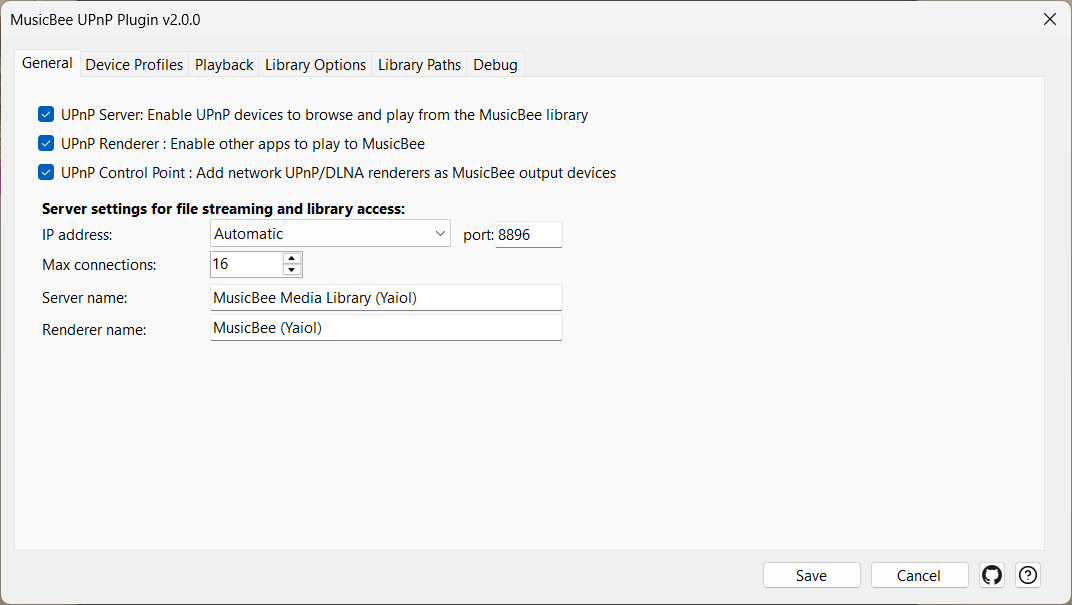
Settings
| Control | What it does |
|---|---|
| UPnP Server: Enable UPnP devices to browse and play from the MusicBee library | Master switch for the Server role — lets UPnP devices browse and play from the MusicBee library. |
| Server name | The name other devices show for MusicBee when they discover it. |
| Max connections | Maximum simultaneous file streams the server will serve (default 16, range 1–256). Raise it if a device firing many parallel requests trips the ⚠ Max Conn badge. Takes effect after a restart. |
| Update play statistics in MusicBee | Counts tracks played over UPnP toward MusicBee's play counts and last-played timestamps. |